
Three hands-on fitting checks I use for petite clothing: painter’s tape sleeves, belt loops as waist anchors, and shoe-height hems.
Blue painter’s tape for sleeve and cuff try-ons

I keep a roll of 1-inch blue painter’s tape in my closet because petite sleeves are the most annoying kind of almost-right. They look fine until you move your arms and the cuff eats your hand, or the sleeve stacks into a sad accordion above your wrist. If you’re trying to decide whether a jacket is worth tailoring (or even worth buying), tape gives you a clean, reversible preview that pins don’t. Pins shift, they snag lining, and they always end up right where your wrist bends.
Here’s how I do it in a fitting room or at home. Put the jacket on and stand like you normally stand. Don’t do a stiff, artificial posture. Find your ideal cuff spot, usually right at the wrist bone for a blazer, a touch longer for a trench, and dead-on at the wrist for a leather jacket so the zipper doesn’t crash into your hand. Now fold the sleeve up to that point. If the fabric is thick, do a shallow fold first, then a second fold so the edge sits flat instead of forming a bulky donut.
Take the tape and make a ring around the sleeve to hold the fold in place. One ring near the seam, one ring opposite it. For really slippery linings, I add a third small strip bridging from outer fabric to lining on the inside, like a little staple. You’re not trying to compress the life out of the sleeve. You’re just holding the fold so you can move around: reach forward like you’re grabbing a steering wheel, bend your elbow like you’re carrying a tote, and lift your arms as if you’re putting your hair up. If the taped fold creeps down right away, that sleeve is going to fight you unless it’s shortened with a proper hem (or the cuff is redesigned).
What I’m looking for is the moment the jacket starts to look made for you instead of like a nice jacket in the wrong scale. On petites, taking even 3/4 inch out of a sleeve can make the shoulder look narrower and the whole coat look sharper, because your hand isn’t disappearing. Tape doesn’t replace a tailor, but it tells you if you’re chasing the right fix before you spend money or commit to a return window.
Use the belt loops to pin the waist where it belongs
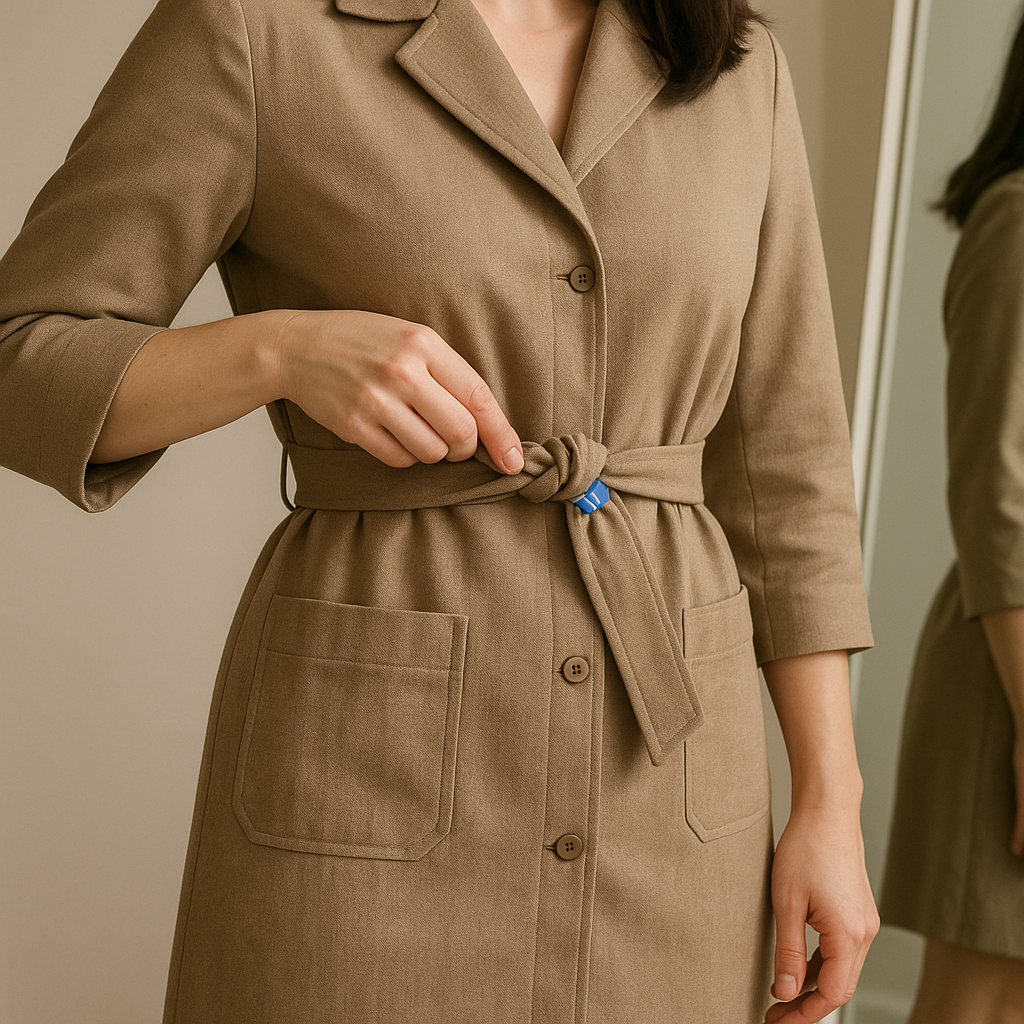
Petite-fitting isn’t only about length. It’s where the shape lands. If the waist seam or the cinch point is sitting down around your high hip, the whole outfit reads droopy, even if the garment technically fits. This is why some of us can wear a perfectly good trench or shirt dress and still look like we’re borrowing it. The waist is doing its job, just on the wrong body map.
When I’m deciding whether a piece is fixable, I use the garment’s own belt loops as my measuring tool. Most coats, trench coats, and shirt dresses have loops stitched into a stable seam. Those loops tell you where the designer intended the belt to sit. On a petite frame, that can be 1 to 3 inches too low.
Try this: put the coat or dress on, thread the belt, and tie it where the loops want it. Look in the mirror from the side. Now, without retying the belt, slide the knot up to your natural waist (the narrowest spot, usually a couple of fingers above your belly button). You’ll see the difference immediately in the torso length and in how long your legs look. The belt will want to migrate back down because the loops are pulling it, so I clip the belt to the loops temporarily with two small binder clips or mini clothespins. It’s a dumb little hack, but it tells the truth fast.
If moving the belt up makes the garment look tailored and intentional, you have options that are worth talking through with a tailor: adding new belt loops higher up, removing the old ones, or in some cases shifting the belt placement if it’s a separate tie. For a trench, new loops are usually the cleanest. For a shirt dress, sometimes I just live with tying above the loops and cutting the loops off entirely if they bug me, but only if the fabric doesn’t show needle marks.
Two details matter when you do this test. First, check the back view. A belt pulled up too high can create a strange pouf of fabric at the lower back if the garment is cut straight. Second, watch the pocket placement. If the pockets now sit low and wide, the waist fix might be fighting the original proportions. That’s not a dealbreaker, but it’s a clue that the piece was drafted for a taller torso and the compromise might not be worth it. This little loop-and-clip check has saved me from buying several almost-right coats that would’ve lived on the hanger forever.
Hem to the shoes you wear, not the shoes you own
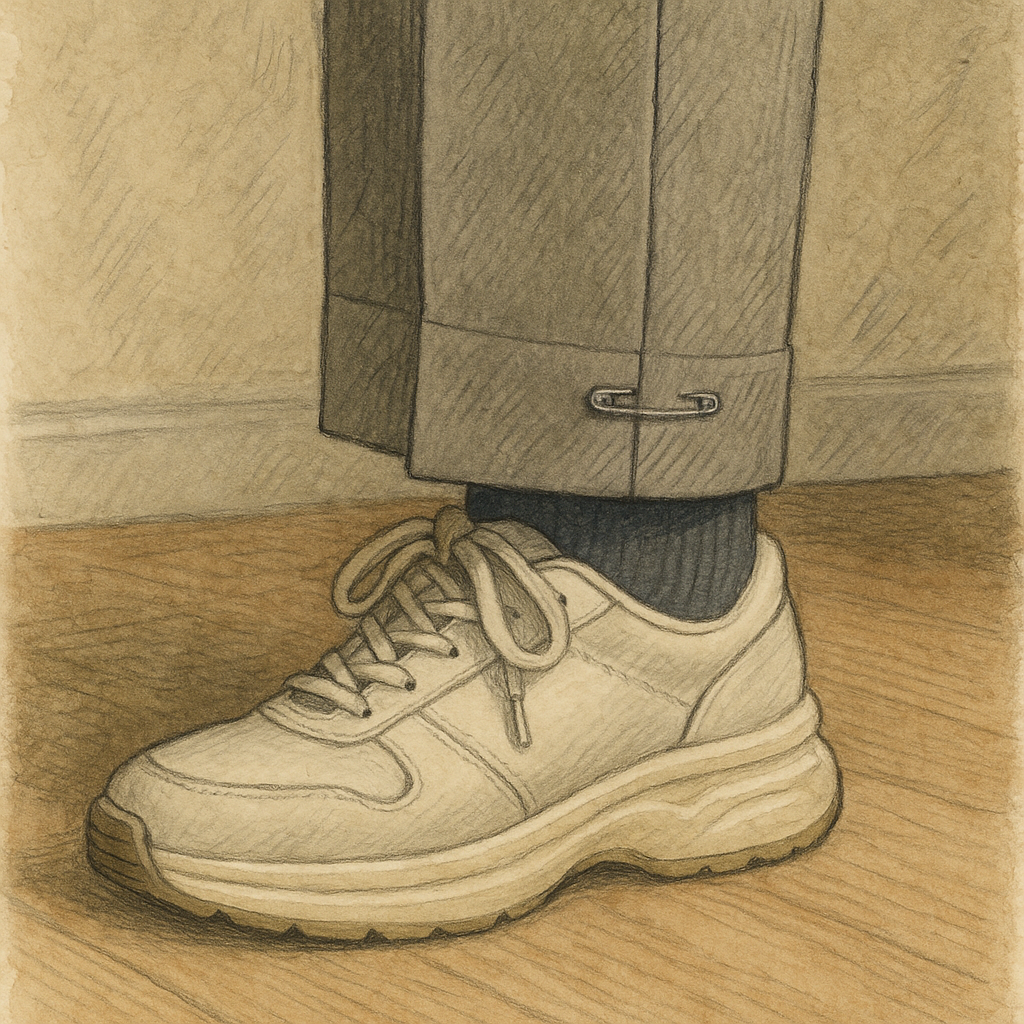
My most expensive hemming mistake wasn’t the price. It was the logic. I hemmed a pair of straight-leg trousers to what I thought was the perfect length in bare feet because I was trying them on at night, in a hurry, and I told myself I’d mostly wear flats anyway. Then I wore them with my everyday sneakers, the ones with a slightly thicker sole, and the hems started kissing the top of the shoe and kicking forward when I walked. Every step looked sloppy. The pants were fine. My process wasn’t.
If you’re petite, a half inch is not a rounding error. It’s the difference between a clean break and fabric puddling at your ankle. So I hem to one specific shoe height per pair, and I pick the shoe I will reach for on a random Tuesday. Not the fantasy heel.
What this looks like in real life: I put on the pants with the shoes, then I use two safety pins per leg to create a temporary hem fold (one at the side seam, one near the inseam). I don’t pin at the very front because that point lies. The front will always look shorter once you start walking, especially with a pointed toe or a chunky sneaker. After pinning, I do a quick walk test on a hard floor. If I hear the faint tick-tick of fabric tapping the shoe, the hem is too long. If the back hem lifts so high it shows sock when I step, it’s too short.
For wide-leg pants, I want the hem to hover just off the floor in those shoes. For straight legs, I like a small break or no break, depending on the fabric weight. Denim can take a little more contact with the shoe without looking wrinkled. Lightweight suiting gets rumpled fast, and petites read rumples as too long instantly.
If you’re taking them to a tailor, bring the shoes. Every time. If you’re hemming at home, press the fold with an iron before you do anything permanent. A crisp press makes the measurement stable and keeps you from chasing a shifting fold line. And if you’re between lengths, go slightly longer. You can always take another 1/4 inch, but adding it back is when hemming turns into a whole project.